
CASE STUDY: Etihad Airways Bring Cockpit and Cabin Logs Together

Masoud Al-Alawi, Manager Aircraft and Digital Operations, Etihad Airways shares the airlines’ experience of deploying and Electronic Cabin Log alongside their approved Electronic Technical Logbook
In this article I want to share our experience of implementing an Electronic Cabin Log at Etihad Airways, including the integration with our already approved and deployed Electronic Technical Logbook. I’ll tell readers about the project and the challenges we encountered along with the benefits that we gained, as well as our next steps looking ahead of the next 12 months.
A relatively young airline compared with other regional operators in the middle East, Etihad Airways was established in 2003 and operates out of Abu Dhabi from the recently opened Zayed International Airport (figure 1).
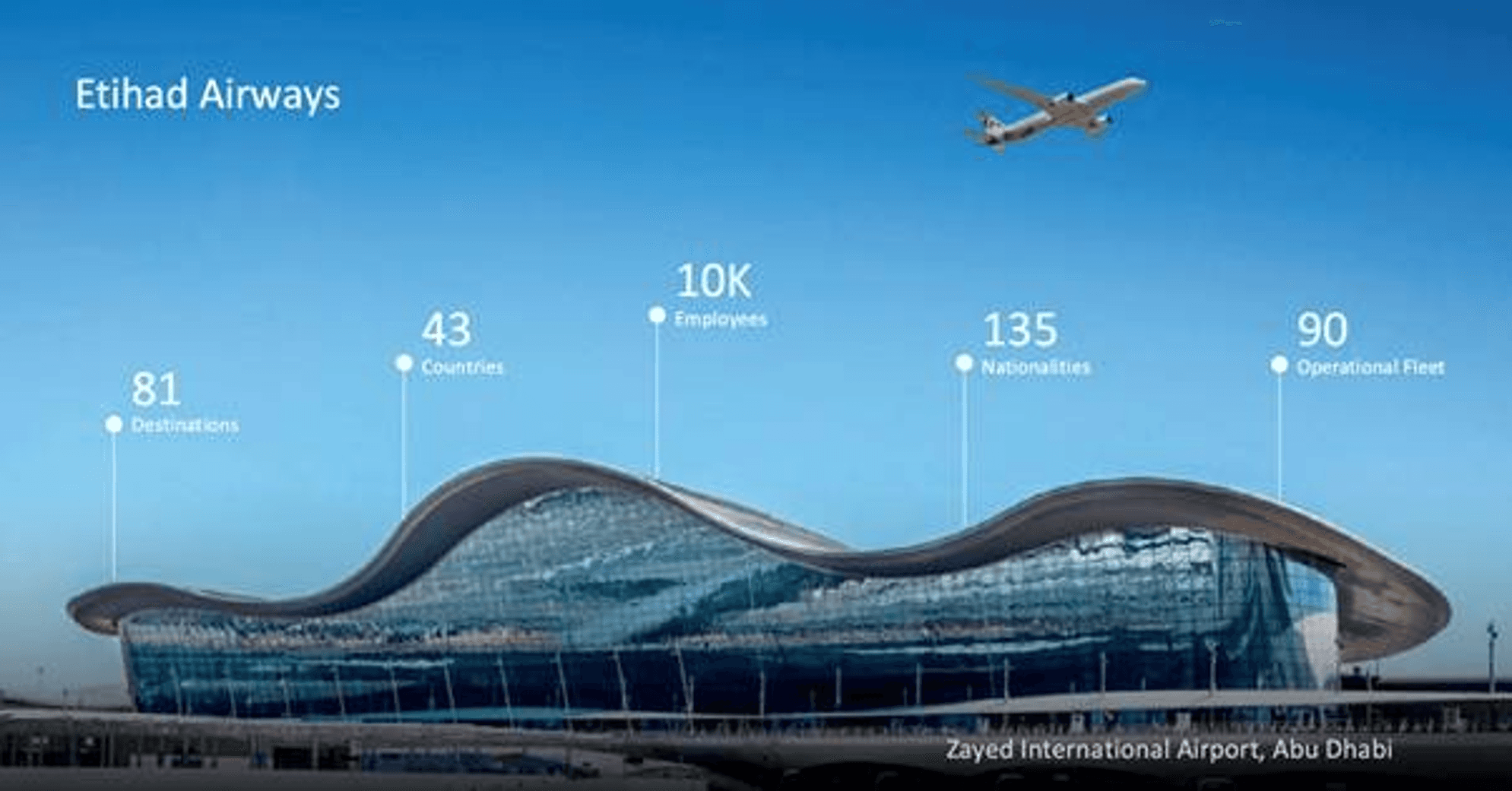
Figure 1.
The new airport is a beautiful structure showcasing state-of-the-art facilities. With 65 gates it has the capacity to handle more than 30 million passengers a year. It also featured in the latest ‘Mission Impossible’ movie – which portrays the full magnificence of this terminal, and we think this is also the perfect symbol for Etihad’s epic growth plan.
The Digitization Journey.
Like Many Airlines, we’ve been investing in digitalization across the board for several years now. We started by consolidating all of our data into single MRO system – in our case AMOS – and used this to streamline many of our processes (figure 2).

Figure 2
We also implemented the Conduce Electronic Technical Logbook, eTechLog8, which was successfully deployed across the whole Etihad fleet starting in 2020, and by 2023 we had also added Conduce’s fully integrated Cabin Logbook solution, eCabinLog8 project is one I’m going to focus on here.
The Electronic Technical Log Project
Our current set-up today follows the successful deployment of our Cabin Log. It consists of two devices on board each aircraft one with eTechLog8 and the other eCabinLog8 (figure 3).
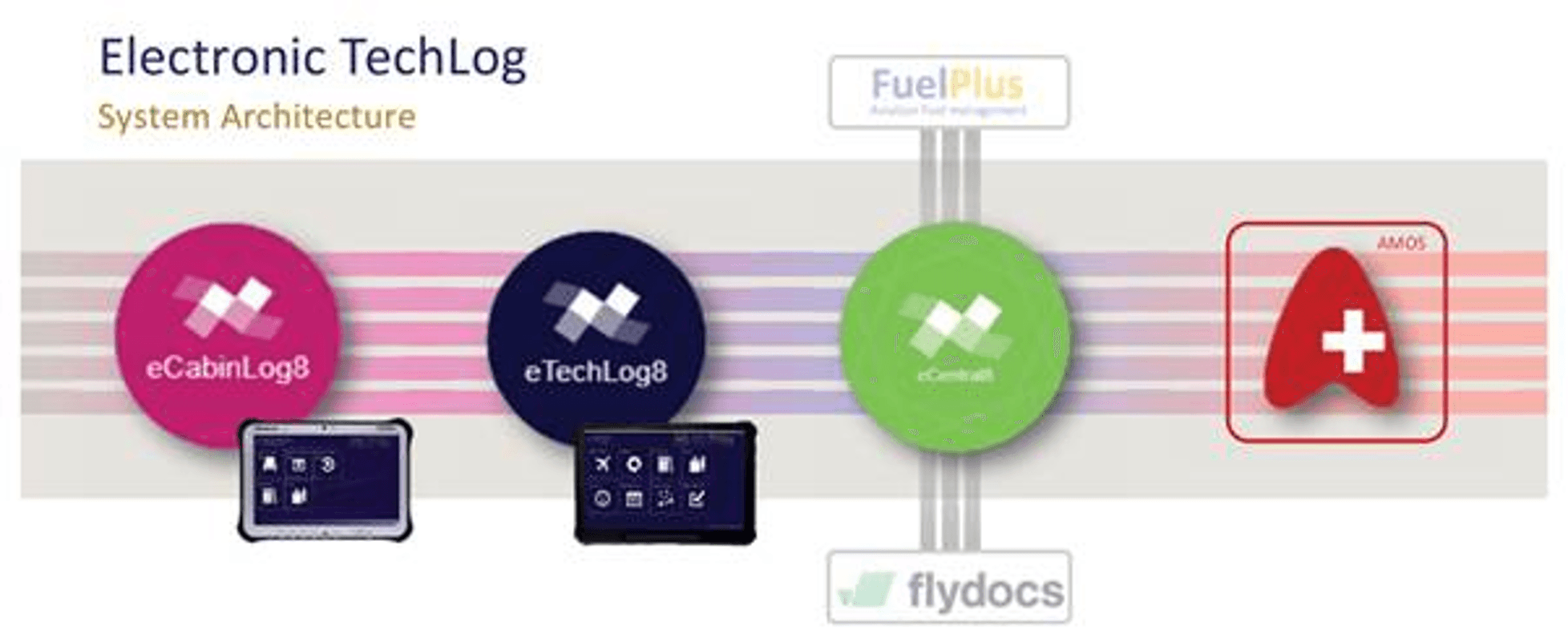
Figure 3.
These two devices communicate directly to each other, using a Peer-to-Peer connection, which we achieve with Wi-Fi hotspots. All of the cabin and tech log data collected on the device is then transmitted to eCentral8, which is the management website. From there, we have seamless integration to AMOS for all flights, defects, and defect actions. In addition, all the completed TLPs (Technical Log Pages) go automatically to Flydocs, and in the future will go to the Fuel Management System. This gives us compete oversight of all aspects of our fleet, from defects to fuel, in the relevant system, in real time.
So how did we achieve this? Like any complex task, we broke it down into individual , achievable phases, starting with the eTechLog8 project in late 2019. Just as we were ready to start our parallel run in March 2020, COVID-19 hit the world. However, we were undeterred, and the project team quickly pivoted to start the parallel run with our freighter aircraft, since much of our passenger fleet had been grounded.
In the face of the fast changing and unexpected challenges COVID-19, we opted to divide the eTechLog8 deployment into three phases (figure 4).
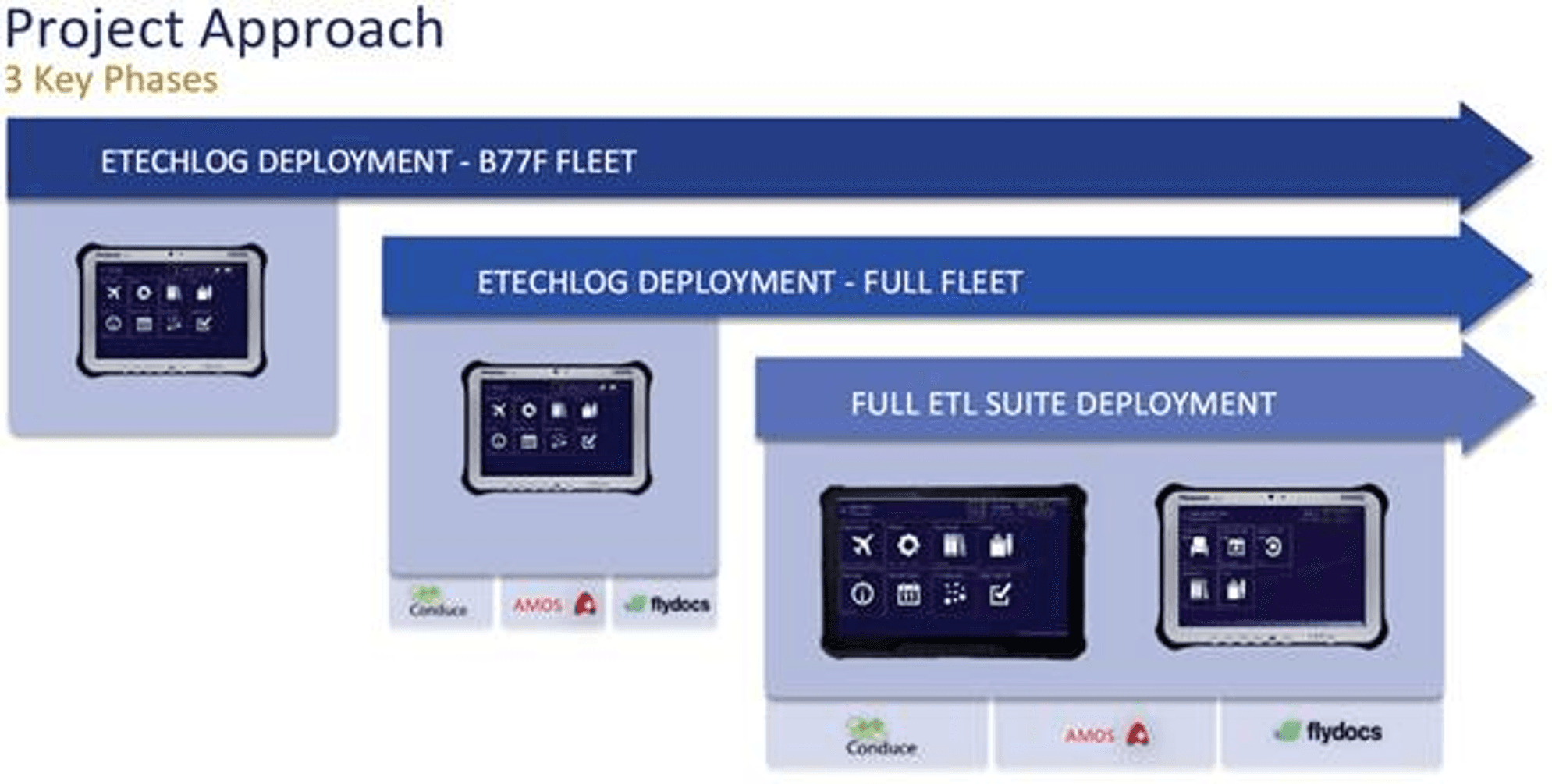
The first phase was simple – change from paper to an electronic device, leaving all the other downstream processes almost unaffected. Then, as the Pandemic moved on, several fleets resumed flying, and as each returned to service we rolled-out the activated the integration with AMOS and really started reaping the benefits of the real time data. As teams became more familiar with the system and the world slowly returned to normal, we added more and more functionality and began thinking about things in a ‘digital first’ way rather than just replacing paper.
At Etihad we put a lot of emphasis on the cabin; our cabin experience and customer service are really important to us. To support that goal, the third phase was to add eCabinLog8, and due to the size and complexity of our cabins, we opted to do this on an additional device.
The complete project from start to finish took approximately three years to complete (figure 5).
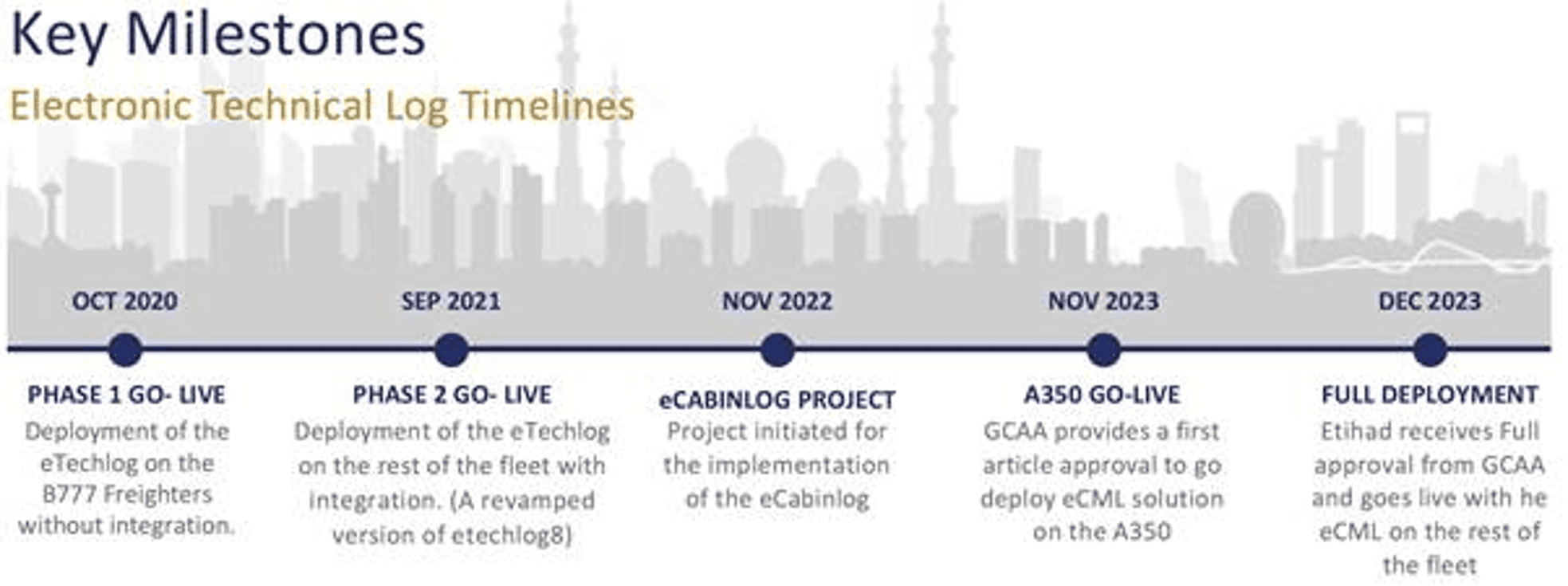
Figure 5
The Electronic Cabin Log Project
In late 2022, our mandate was to introduce the eCabinlog8 as an additional device on board the aircraft and go live by the1st of November 2023. With this in mind we approached our eTechLog8 provider, conduce.
Conduce already had a very basic Cabin Log, but this didn’t meet our requirements, so we agreed to go back to the drawing board and began designing a fresh solution together. We had several key requirements; for example , we needed all our cabin defects to be integrated into AMOS, regardless of whether there were safety or non- safety defects. This is because we wanted to have full oversight of our cabin defect control and management in AMOS.
There were several bigger requirements, some of which were very technically challenging. But we worked closely together to come up with several different iterations ofeCabinLog8,each time meeting those requirements in different ways and moving closer to our dream Cabin Log system.
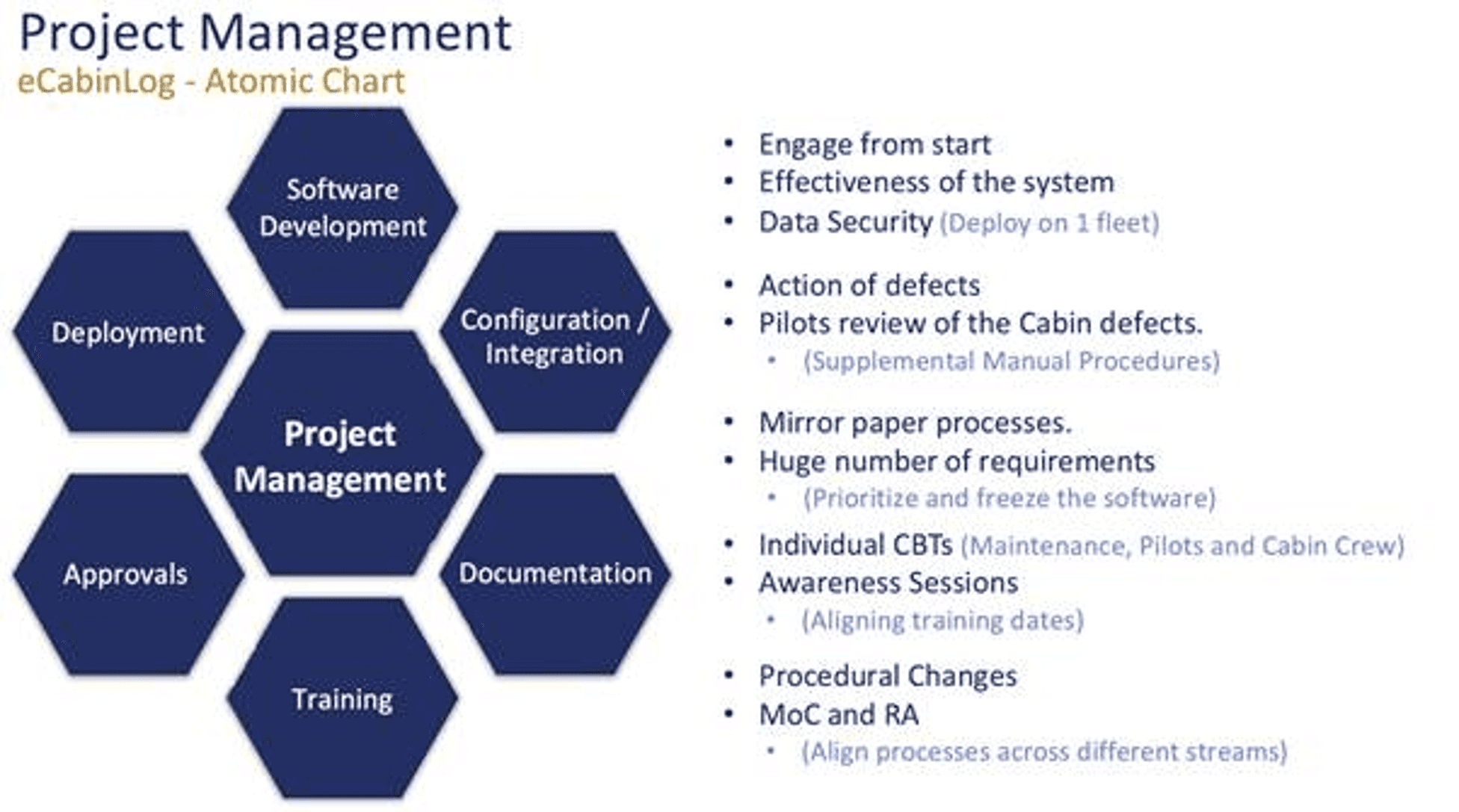
In summary, the third phase, introducing eCabinLog8, took little over a year and the key steps are categorised into what we referred to as the Atomic Chart (figure 6).
Figure 6
Challenges As the Project Progressed, input from the stakeholders and their own requirements started increasing. We soon became aware that we only had limited time to meet our deliverables and agreed with Conduce which requirements could be added later. In light of that experience, my advice to anybody who is undertaking a similar project is that it is definitely sensible to have all of your requirements agreed well in advance of the project and ensure those requirements are understood by everyone and are achievable, well before the timeline is agreed.
One of the big challenges that we faced with the implementation of eCabinLog8 was adding a second device into the mix and, on top of that, a different type of hardware. We had used Panasonic devices for the eTechLog8, that was working well, but unfortunately those devices were discontinued before we started the eCabvinLog8 project. After extensive testing, Conduce advised us to go with a new Dell device. When you have two different devices, and one is more technologically advanced, the question of whether or not you’re going to deploy the devices based on fleet or software or a mix of both becomes challenging. To answer these questions, we had to understand the downstream impact of each choice. Ultimately we opted to use the devices totally interchangeably, but to try and place the newer Dell device as the eTechLog8 device where possible. The newer device was of higher spec, had a bigger screen which our pilots liked, and also benefited from newer comms, giving us 5G connections.
In any project documentation is one of those boring tasks that need to be accomplished. The impact of this project was wider and therefore in addition to the maintenance and flight crew procedures we also had cabin crew procedures to change. We needed to ensure that everyone had aligned and that there was no ambiguity. Vital documents included by our Management of Change and Risk Assessment. We approached this by creating one Management of Change document, and then each stake holder (the pilots , the cabin crew, Maintenance, CAMO etc) all created their own risk assessments surrounding the implantation of this process. This was an effective was off managing a large and complex process and allowed each stakeholder to cover their own area of expertise.
Training might seem like it should be one of the easiest challenges; you just need to create the training materials and then deploy it. But this was actually a hugely complex challenge due to the sheer number of people involved. When we deployed eTechLog8, we needed to train all the Pilots and Engineers, but thus was made easier in part due to the fleet-by-fleet roll-out. However with the Cabin Log there was a huge number of Cabin Crew to be trained, as well as, additional training needed for Pilots and engineers to show them the aspects of the system, especially around pairing the two devices together. So, to achieve this we created three different CBT (Computer Based Training) programmes-one for maintenance (both base and outstations), one for Cabin crew and one for the pilots. On top of that we had numerous awareness sessions especially for the cabin crew, who were getting this system for the first time.
Naturally, getting regulatory authority approval was key to the success of this project. We engaged with our authorities very early in the project. This meant that we understood their concerns and their expectation. Our authorities were particularly interested in the training, especially outstation training. They were also interested in data security, so we worked with Conduce to take the devices through several penetration tests. Those tests were a key part of the supporting documents that we sent to the authority for regulatory approval to add the eCabinLog8 system into our existing, approved, eTechLog8 system.
Our Authority wanted us to monitor the effectiveness of the CabinLog, which was quite a challenge since eTechLog8 was already alive system. We could not run trails outside of the live system, as eCabinLog8 isa companion application toeTecgLog8 we decided to deploy it to a single fleet in production for one month and run the monitoring to understand and identify any areas that needed to change before the full deployment. In this initial month , we had a few software glitches and some issues with the new hardware which Conduce quickly patched. Some training gaps were also identified so we enforced the awareness sessions a little more proactively to ensure that people fully understood the change before it came to the full fleet.
Lastly came the full deployment., Unlike eTechLog8, which was deployed as the fleets returned to service we had just one month to deploy eCabinLog8,all day every day. By prioritizing our resources in this way we managed to deploy four to five aircraft every day and around 1,6000 cabin defects were transferred from paper into the system in just a few short weeks. I want to thank everyone who made that possible with a lot of determination and hard work.
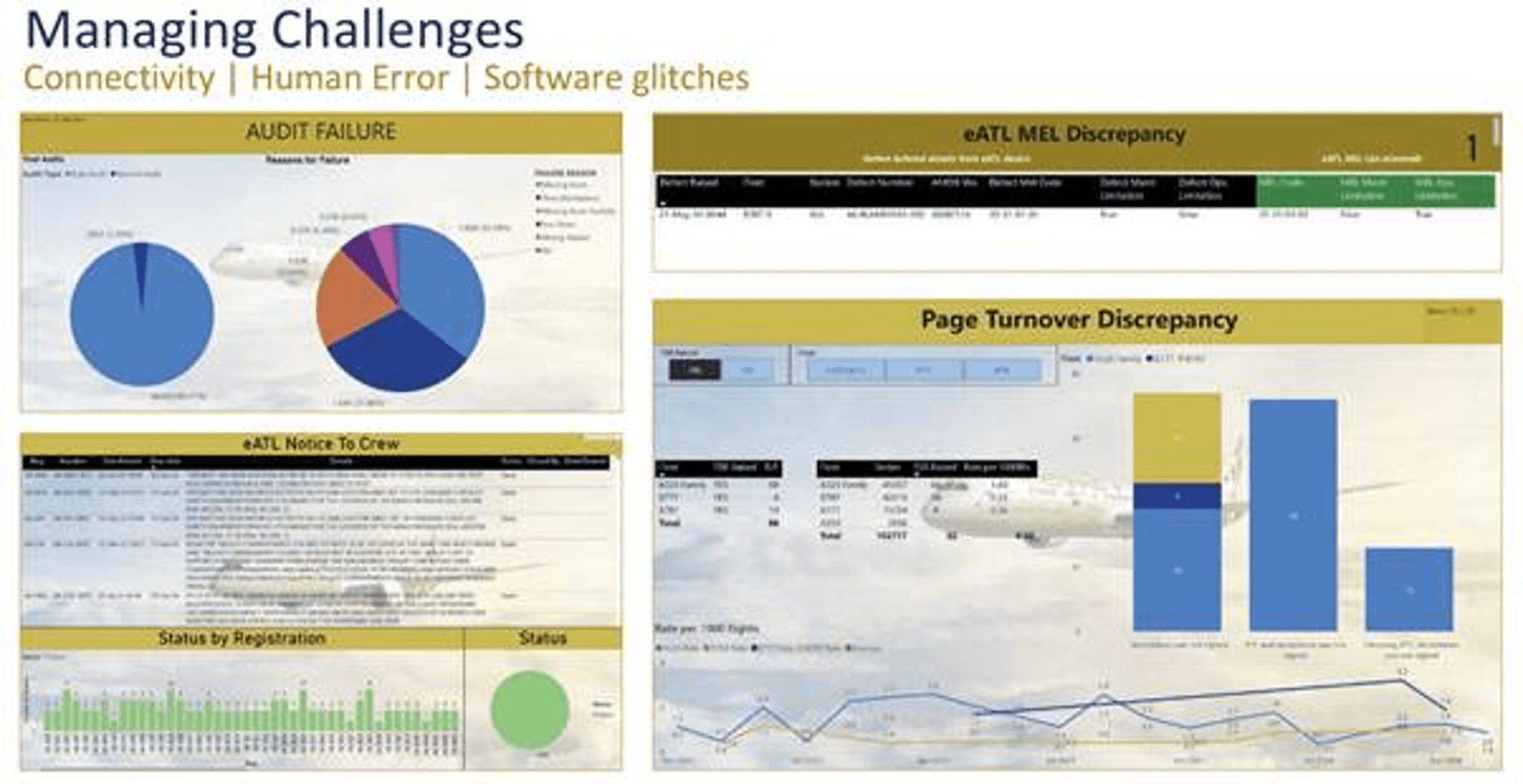
Several of the challenges I’ve mentioned in this article are challenges inherent to any system. At Etihad we have built several Power Bi reports to help us monitor the systems we’ve implemented and to help us to spot issues before they cause us a delay or non-compliance (figure 7).
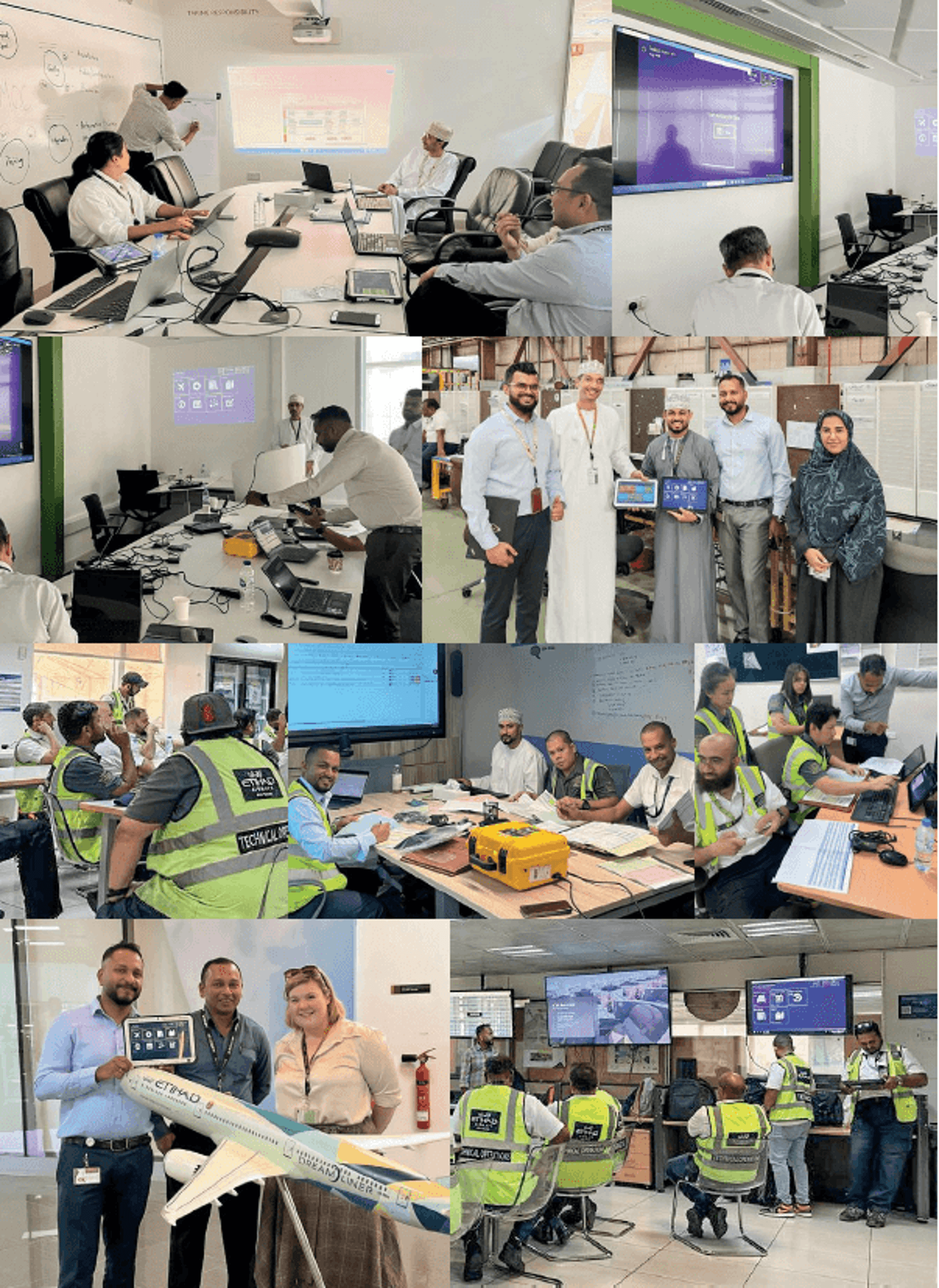
Lastly there are no projects without fond memories.
Benefits
When we look at benefits we like to visualize them as an iceberg (figure 8).
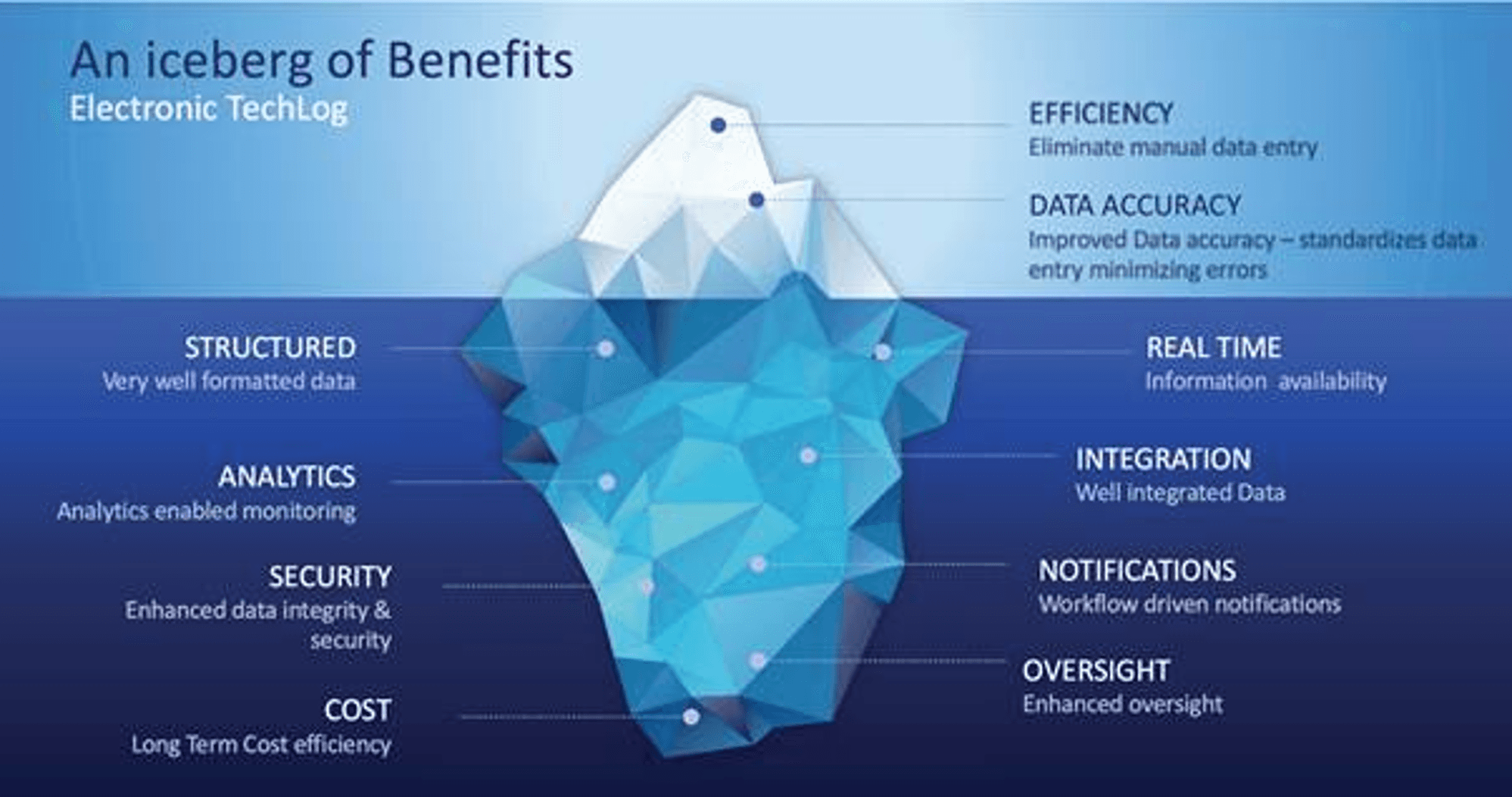
The tip represents the immediate benefits of eTechLog8/eCabinLog8. It quickly becomes obvious that errors are minimized and manual data input is almost zero giving huge efficiency gains. However, when you start looking at the iceberg underneath the waterline, then the real benefits start to appear. Since we now have real-time structured data; this means we can do a lot more. For example, with seamless integration, we can do a lot more analytics; there are notifications and alerts that can be triggered.
There is so much more that cannot be quantified but supports what we are always aiming for; better oversight and control of our aircraft data. We originally used the cost savings on just the paper to justify the cost of implementing eTechLog8, but all of these other benefits, both quantitively and qualitatively, start to come into the picture now that we are thinking in a digital native way.
Specifically with the addition of the eCabinLog8 system, our reliability team created using this data to build up a dashboard for our cabins (figure 8.1 and 8.2).

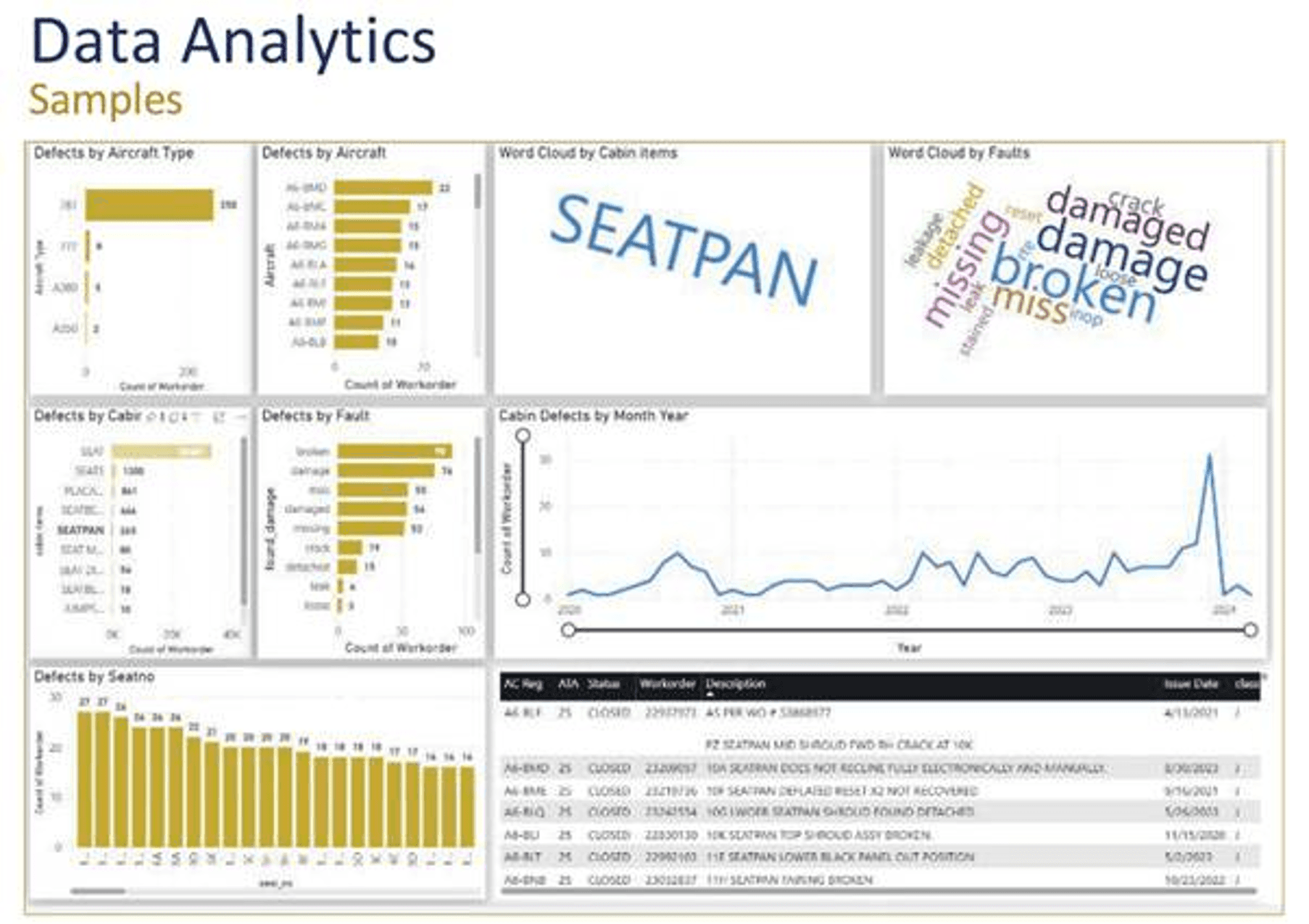
It is still a work in progress and we ill refine it as we continue to work with eCabinLog8. We’re also working on pulling that same data into a LOPA (Layout Of Passenger Accommodations) in order to identify the areas most prone to defects. In the future, we want to take advantage of machine learning models to come up with preventative maintenance. This means one day we will prevent the defects before they even happen.
We also use the LOPA chart directly in eCabinLog8; it’s an interactive chart we upload to the devices on board the aircraft (figure 9).
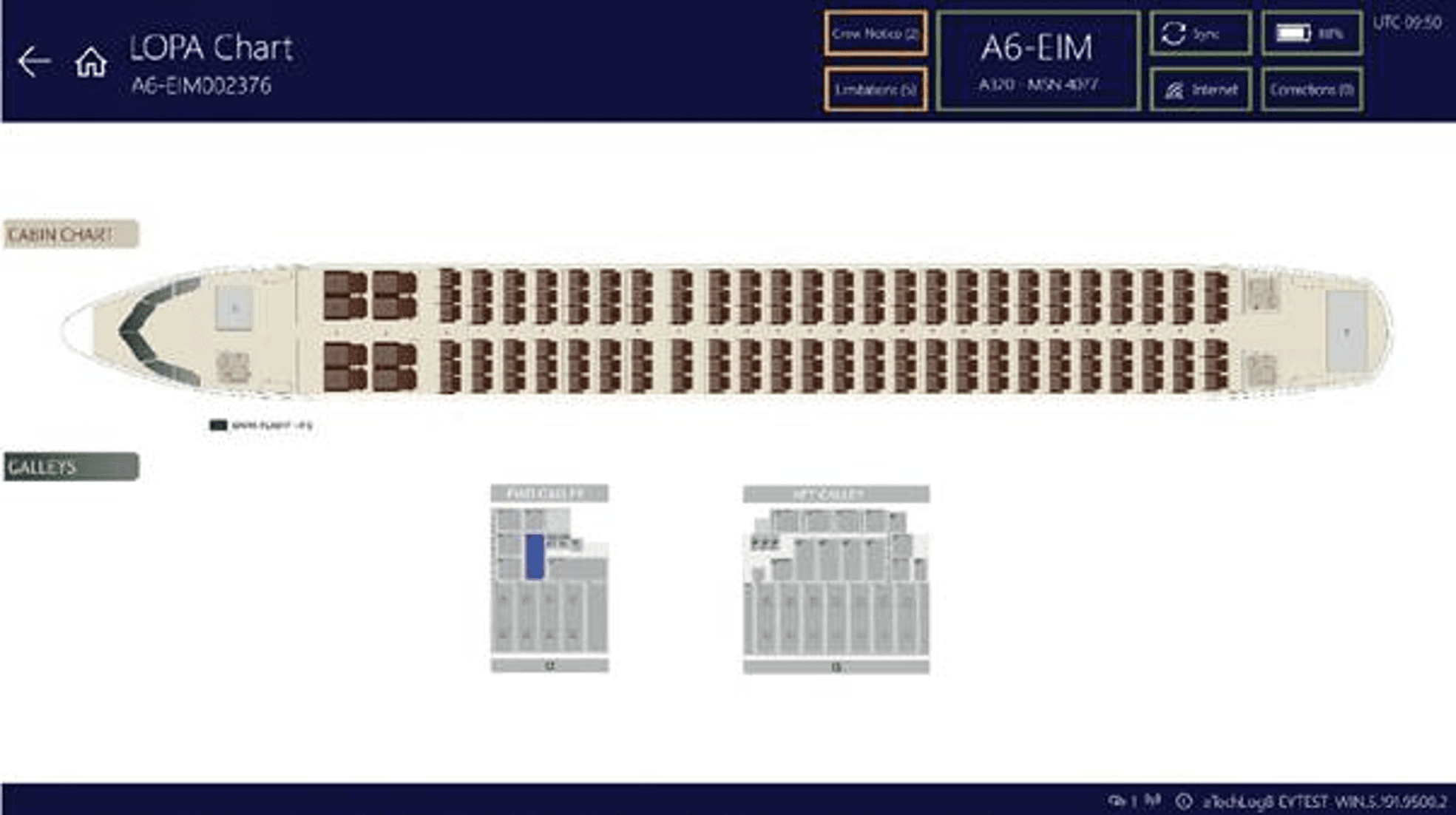
I have included this in particular because before we went live with eCabinLog8 we would regularly see duplicate defects getting raised several times, because the cabin crew could not easily identify if a defect had already been raised by a previous crew in the paper-based system. I know this is a common problem across the industry. With the interactive LOPA, the visualisation makes it easy for the Cabin Crew to instantly identify a pre-existing defect. That means that now we have deployed eCabinLog8, duplication of cabin defects at Etihad is down to almost zero.
The Future
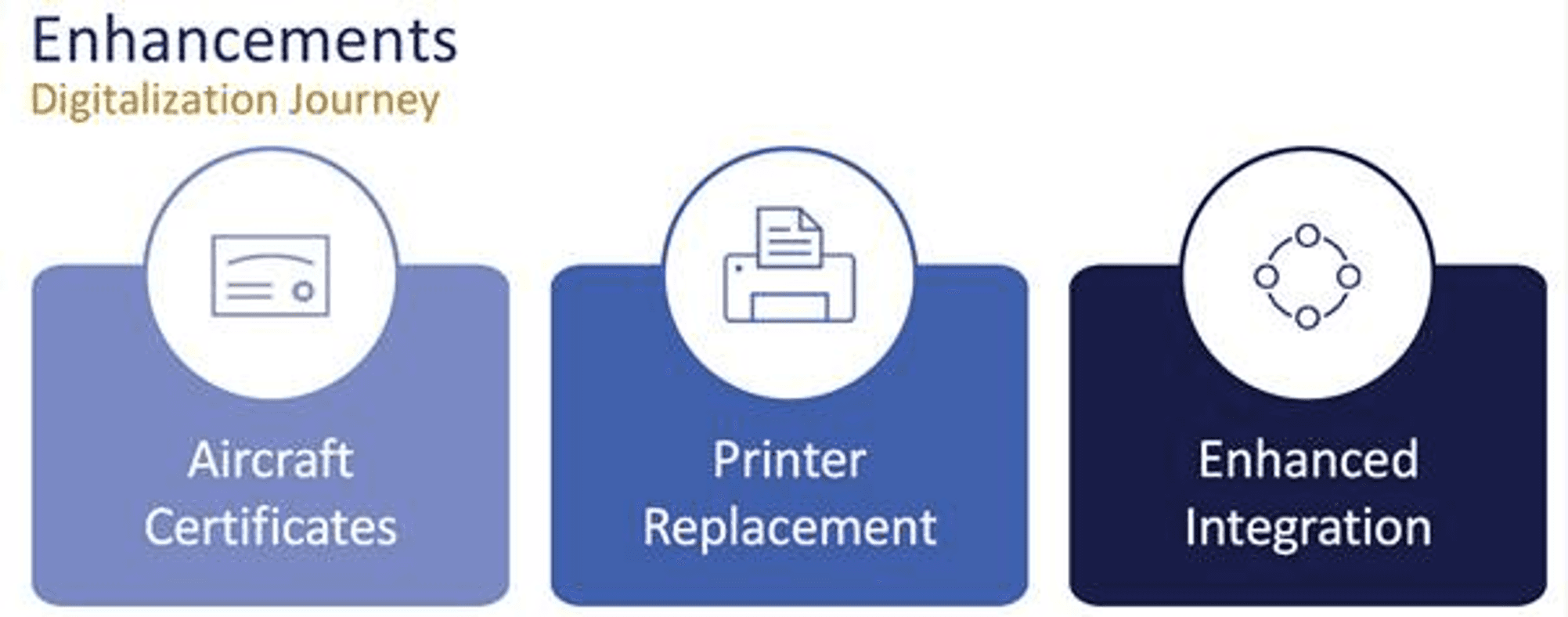
Our digitalisation Journey continues ; what are we planning to do in the next twelve months? Well, a lot of things (figure 10)
We’re implementing AMOS eSigniture in 2024, and are also consolidating all of our documents and data into a digital platform that will allow our engineers to have access to the data they need, anywhere, anytime, and on any device.
We’re collaborating with various vendors on data exchanges to make more use of the real-time data. For example, we are working with Boeing parts exchange and one of the engine OEMs. Our end goal is to enable all our systems to talk to each other. We are exploring machine learning and working in collaboration with a local university which specialises in artificial intelligence to come up with a model that we can incorporate into our processes and improve our performance.
On the specific use of the tech log, we want to replace their aircraft certificates with a digital format and use the eTechLog8 devices to maintain such documents. It’s an area where there are a lot of questions and doubts, but we want to continue to leverage the eTechLog8 system to get further away from the paper-based world. We are also planning to replace the Conduce provided printers to reduce weight. Lastly we are working with conduce to increase and enhance integration in order to gain more benefits.
Our journey continues, but I hope that sharing the Etihad eTechLog8 and eCabinLog8 story with you will be useful for any reader considering embarking on a similar project.
Written by,
Masoud Al-Alawi
Masoud has over 23 years aviation experience including project management, reliability program implementation, technical publication control and procedural and process optimisation at Gulf Air, Oman Air and Etihad Airways. He has been involved in high profile initiatives including reduction of direct maintenance costs using reliability analytical tools, stringent modification cost controls and spearheading procedural process enhancements. Currently in Etihad’s Technical digital transformation. Masoud is responsible for harnessing aircraft digital platforms to enhance operational efficiencies.