
ELB/ETLs and Electronic Signature 2026

A Brief History
The concept of an electronic signature, an electronic rendition of signing your name, is not new, even in aviation. In fact, aviation has been using electronically transmitted signatures since the earliest days of flight. Orville Wright’s famous 1903 telegram to his father confirming the first successful flights of the Wright Flyer included his signed name at the bottom of the message.
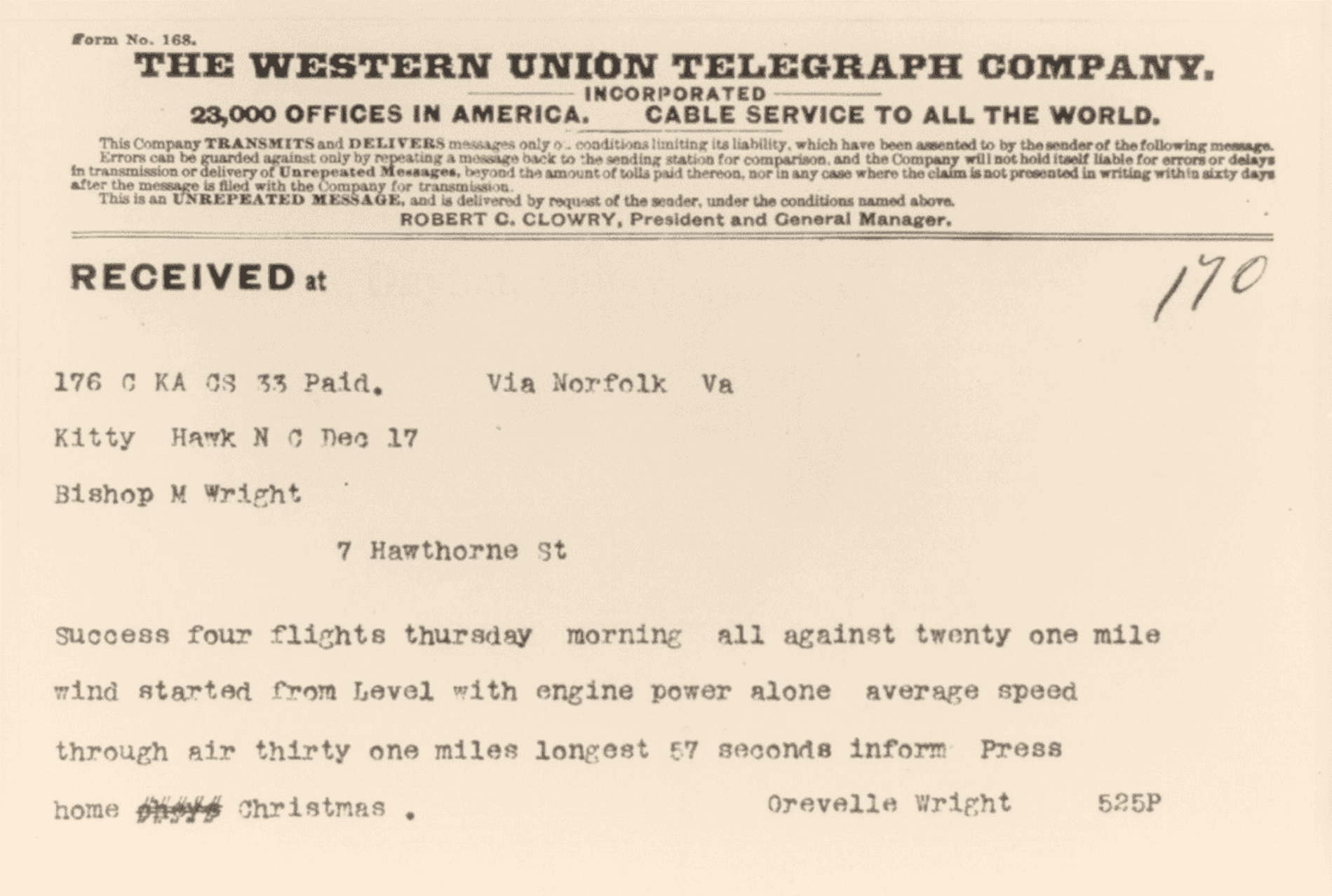
Orville Wright’s telegram to his father confirming the first successful four flights of his heavier-than-air flying machine in 1903. Orville has signed his name at the bottom of the Telegram, arguably the aviation industry’s first electronic signature.
Electronic signatures have become more widely adopted as aviation systems moved onto electronic software platforms from the late 1980s onwards, particularly within MRO and Maintenance & Engineering systems. These systems were generally designed for back-office users operating in stable, connected environments, and often implemented additional digital signature controls alongside the electronic signature itself for added security and identity assurance.
It is tempting to apply the same approach directly to Electronic Logbook (ELB/ETL) solutions. However, cockpit and line maintenance operations present a very different operational environment from a traditional office. Pilots and engineers require signing processes that are fast, practical, intuitive, and resilient to poor or zero connectivity, while still maintaining the traceability, accountability, authentication, and auditability required by aviation authorities.
Conduce’s “Sign On Glass” approach was specifically designed around these operational realities, closely replicating the familiarity and usability of a traditional handwritten signature process while still meeting the regulatory and operational requirements for electronic signatures in aviation.
Some Definitions
This is a complicated subject, and in aviation we love our acronyms! Here’s some definitions so we’re all on the same page.
Item | Definition |
Electronic Signature | This is an electronic form of a handwritten signature. |
Digital Signature | This is a signature where metadata (not the signature itself) is cryptographically validated. Usually this requires an internet connection and is not practical for the operational environment of ELB/ETLs. |
Sign on Glass | Sign on Glass means the signature on the device is captured exactly in the same manner as it would be captured on paper, using a dedicated stylus on a glass device screen. This means the signature has the same validity as a handwritten signature. Conduce uniquely hold a lifetime licence from Rolls Royce to use a Sign on Glass signature for an ELB/ETL. |
FAA | Federal Aviation Administration. The government agency within the U.S. Department of Transportation that regulates civil aviation. Many countries outside of the U.S. align with FAA or EASA regulations. |
EASA | European Aviation Safety Agency. EASA are the regulatory body that all national aviation authorities are governed by within the EU. Many countries outside of the EU align with EASA or FAA regulations. |
eIDAS | eIDAS is the name commonly used to refer to Regulation (EU) No 910/2014 of the European Parliament and of the Council of 23 July 2014 on electronic identification and trust services for electronic transactions in the internal market and repealing Directive 1999/93/EC It’s the EU regulations on Electronic Signatures relevant to all industries. |
AES (eIDAS) | Advanced Electronic Signature. This is an electronic signature level within eIDAS which is uniquely linked to the signatory, capable of identifying them, created using electronic signature creation data that the signatory can use under their sole control, and linked to the signed data in such a way that any subsequent change is detectable. This is the level of signature required for ELB/ETLs. |
QES (eIDAS) | Qualified Electronic Signature. This is a digital signature level within eIDAS that has all the attributes of an AES but additionally uses a qualified certificate issued by a qualified trust service provider to validate the signature. This basically means each signatory has a unique token (e.g. a smart card or USB drive) with a private key, and a corresponding certificate on the signature creation device. |
What is required of ELB/ETL eSignature
The EU has adopted the eIDAS regulation as the legal framework for electronic signatures across industries. In aviation, EASA’s 2023 guidance aligns aviation digital records and signatures with eIDAS standards, supporting the use of electronic documents such as ELBs and ETLs.
In the US, electronic signatures are governed by the e-Sign Act and UETA, with FAA guidance provided through AC 120-78B for electronic aviation records and signatures. Conduce’s “Sign On Glass” signature process complies with these requirements and is legally acceptable under US regulations.
EASA Regulations
In May 2023, EASA published the Guidelines on the use of electronic documents, records, and signatures, formally aligning aviation guidance with the EU eIDAS framework for electronic signatures. Under this guidance, EASA adopts the eIDAS terminology of Simple Electronic Signatures (SES), Advanced Electronic Signatures (AES/AdES), and Qualified Electronic Signatures (QES).
In June 2024, Conduce attended the IATA ELB/ETL Airline Forum, where airlines, vendors, and representatives from both EASA and the FAA discussed industry best practice and operational experience. During these discussions, Alberto Fernandez-Lopez of EASA, who had been involved in drafting the May 2023 guidance, stated unequivocally that an Advanced Electronic Signature (AES) should be more than sufficient specifically for Electronic Technical Logbook operations.
Conduce’s “Sign on Glass” signature process has been specifically designed to meet the requirements of an Advanced Electronic Signature while remaining practical and operationally efficient for real-world cockpit and line maintenance environments.
How does Conduce Sign on Glass meet AES?
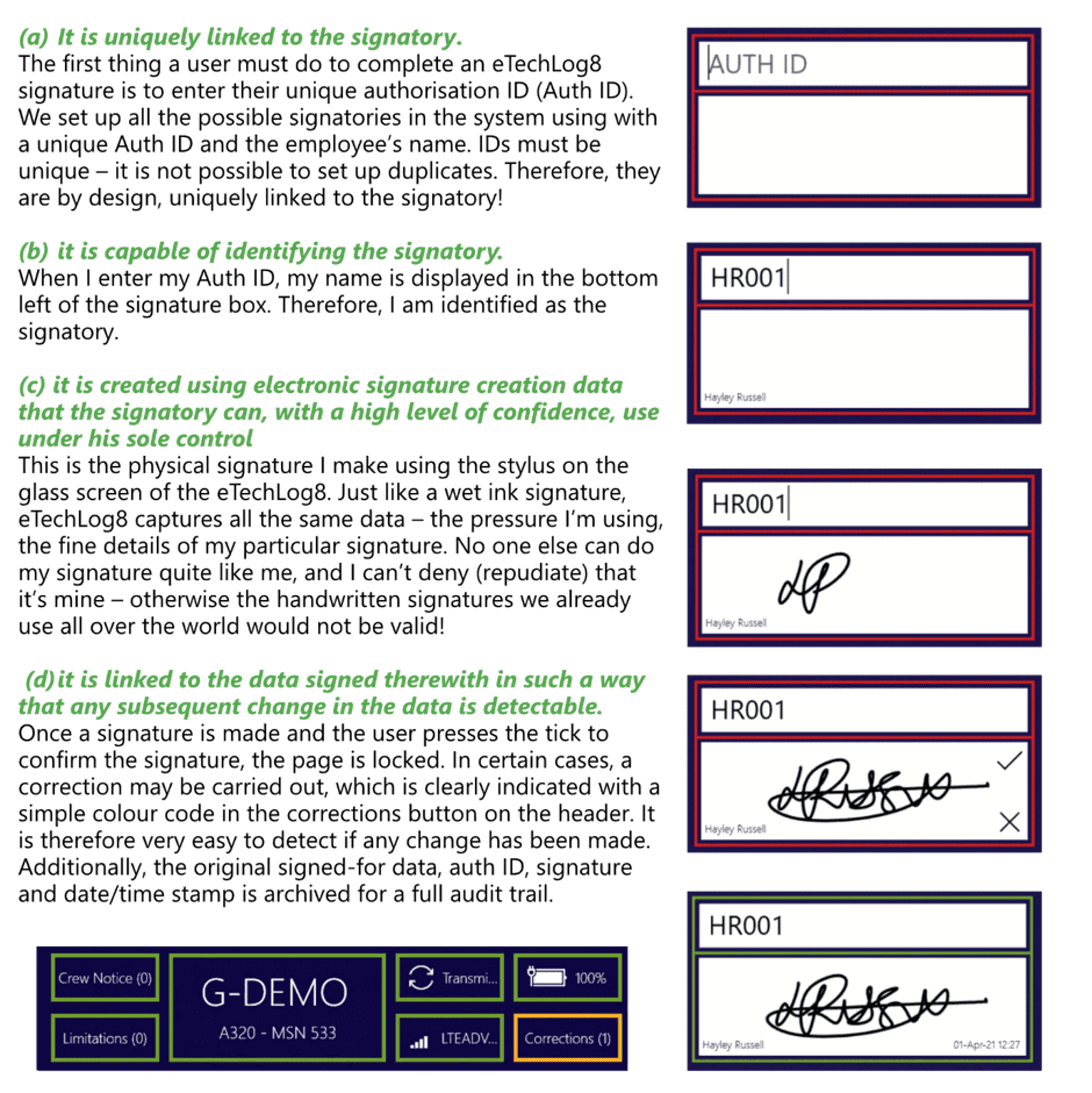
In eIDAS Section 4, Article 26 we have the requirements for an Advanced Electronic Signature.
Article 26 - Requirements for advanced electronic signatures
An advanced electronic signature shall meet the following requirements:
(a) it is uniquely linked to the signatory;
(b) it is capable of identifying the signatory;
(c) it is created using electronic signature creation data that the signatory can, with a high level of confidence, use under his sole control; and
(d) it is linked to the data signed therewith in such a way that any subsequent change in the data is detectable.
Conduce’s Sign on Glass meets all of these requirements. Let’s see how.
What about QES?
Based on the conversation with EASA at IATA and our understanding of the published guidance, Conduce does not believe that any authority should require an QES for eTechLog8. In fact, the Guidelines on the use of electronic documents, records, and signatures explicitly states:
“The assurance level of a signature must match the criticality of the document and reflect the needs of the receiving party or of a yet-unknown third party to validate the authenticity of the signatory without being over-burdensome on administration”
An AES is an electronic form of a handwritten signature along with some key attributes, as demonstrated above. A QES is a digital signature with an encryption mechanism for giving the electronic signature extra security. There are several reasons why digital signatures are not suitable for ELB/ETL solutions, but a key blocker is that a digital signature requires an internet connection. In contrast, an ELB/ETL solution must be fully native. This means it should work seamlessly with or without an internet connection. If the solution is not native it can cause expensive delays or become a safety issue. A digital signature isn’t practical for the operational environment of an ELB/ETL.
It’s also worth considering what we are really protecting with a QES? Engineers and Pilots already go through extensive checks and training and must be in a secure airside area to get access to the aircraft and it’s ELB/ETL. If a bad actor gets into this arena, it’s extremely unlikely they would choose to sabotage an operation by a false ELB/ETL entry. All of the existing processes that protect the paper logbook continue to apply with an ELB/ETL, but many additional safety benefits are added!
FAA Regulations
In the USA the legal framework for electronic signatures currently comprises two statutes, the e-Sign and the UETA. Industry specific regulations then follow up on the e-Sign and UETA.
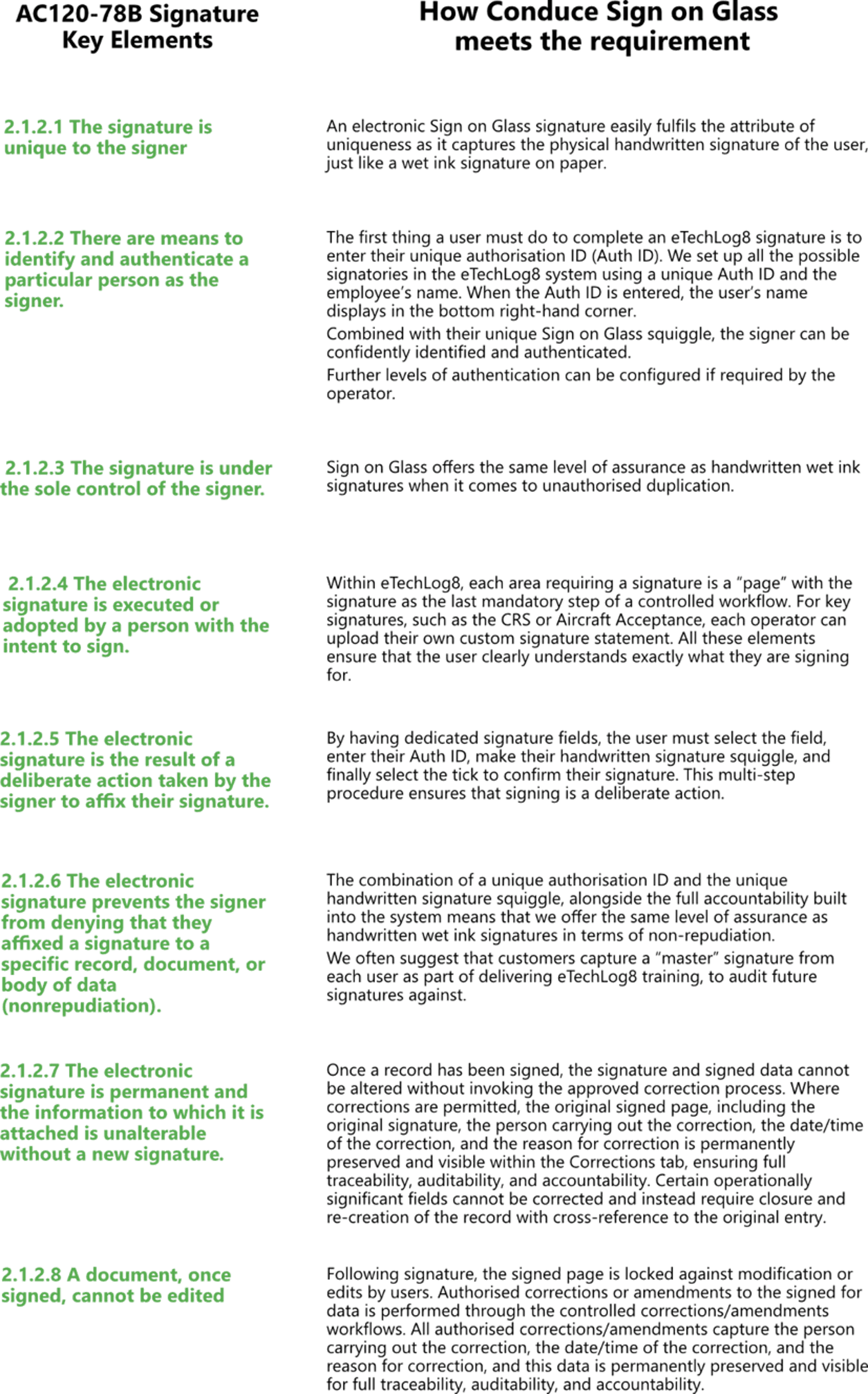
For the aviation industry, the FAA issued the AC 120-78B dated 11 December 2024 as a soft law tool (i.e., it is not an enforceable law) that operators could use when signatures, records or manuals are electronic. It specifically highlights Maintenance Logbooks and other associated documents in the scope. OpSpec A025 is used by the FAA to authorise the use of electronic signatures. For a commercial operator seeking A025 approval for an ETL/electronic signature system, the FAA expectation is typically that the operator documents and demonstrates that the system and procedures satisfy AC 120-78B principles.
So, what are those principles? According to section 2.1.2 of AC 120-78B, there are key elements which comprise an electronic signature and ensure its validity. There are eight key elements:
Other Regulations
Conduce eTechLog8 is widely approved globally across more than 25 countries, including jurisdictions outside both EASA and FAA oversight. Many aviation authorities do choose to align closely with either EASA or FAA regulatory principles, meaning that demonstrated compliance with eIDAS and AC 120-78B is often sufficient.
However, some countries have specific national requirements relating to electronic signatures, electronic records, or data integrity across all industries. Conduce has extensive experience supporting operators and authorities through whatever approval process is required, including the provision of detailed compliance evidence, operational documentation, and independent third-party assessments as required.
Because eTechLog8 uses a true “Sign on Glass” signing process, closely replicating traditional handwritten signature workflows while providing enhanced traceability, auditability, and record integrity, the system has consistently proven acceptable to aviation authorities wherever handwritten signatures are already legally recognised.
Conclusion
Electronic signatures for ETL/ELBs are now well established and are explicitly supported under both EASA and FAA guidance, as well as by many other national aviation authorities (NAAs) worldwide. While terminology and implementation approaches vary between countries, authorities consistently ask us to show compliance with the same core principles. These are ultimately the same attributes that make any signature, whether wet ink or electronic, legitimate: uniqueness, significance, scope, security, non-repudiation, and traceability!
Conduce’s “Sign On Glass” approach has been designed around these principles, and around the operational realities of the Cockpit and the Line. Rather than forcing complex, permanently connected digital signatures into operational aviation environments, eTechLog8 provides an intuitive signature process that mirrors the familiarity and deliberate action of a traditional handwritten signature, whilst still delivering the traceability, accountability, and control expected from a modern electronic logbook.
Today, eTechLog8 is fully approved across more than 25 countries around the world, including approvals under EASA, FAA, and many other NAAs. Conduce has extensive experience supporting operators through the approval process and, in many regions, has been the first ETL/ELB provider to successfully achieve regulatory approval.
Ultimately, approval always remains subject to the requirements of the local NAA and focus on the operator’s ability to demonstrate safe and compliant use of eTechLog8. Remember, the Conduce team are on hand to support you in any way you need in order to do that!